Chat GPT Ads: A Complete Guide For Businesses (2026)


Yes, ChatGPT now shows ads to users, and OpenAI is rolling out ad formats to advertisers in select markets, including Australia. If you're a marketing manager or business owner wondering whether this is a channel worth your budget, the short answer is: it's early, but it's moving fast, and the businesses testing now will have a head start.
We've set up ChatGPT ads for our own accounts to see how it actually works in practice, not just what OpenAI says in its announcements. Here's everything we've learned, plus what we still don't know.
What Are ChatGPT Ads?
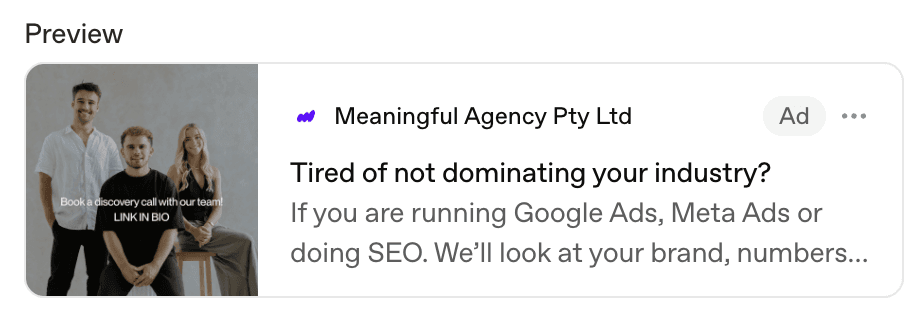
ChatGPT ads are sponsored placements that appear within conversations on ChatGPT, either as a distinct ad unit below a response or as a "sponsored" tag on a product or brand mentioned in an answer. They're not the same as traditional search ads. There's no results page to bid on, and there's no keyword auction in the way Google Ads works.
Instead, OpenAI is leaning on:
Conversational context: ads are matched to what the user is actually asking about in that session.
Account and usage signals: things like location, device, and possibly ChatGPT Plus/Enterprise status.
Advertiser-supplied creative: short-form text and, in some formats, product images or links, similar in spirit to a Shopping ad.
If you've read our piece on how AI chatbots are changing SEO, you'll know this fits a broader pattern. AI platforms are becoming discovery engines in their own right, not just answer engines.
How ChatGPT Ads Compare to Google Ads and Meta Ads
The biggest shift is that there's no query-based auction to "win." Here's how the models stack up:
Google Ads | Meta Ads | ChatGPT Ads | |
|---|---|---|---|
Trigger | Keyword search | Interest/behaviour signals | Conversation context |
Buying model | CPC/CPM auction | CPM auction | CPM (early access), CPC can be set |
Targeting depth | High (keywords, audiences, intent) | High (interest, lookalike, retargeting) | Early stage, contextual only so far |
Creative format | Text, Shopping, video | Image, video, carousel | Text-based, some product cards |
Measurement maturity | Very mature | Very mature | Early, limited API access |
What Metrics Can You Actually Select in Australia?
For Australian advertisers in the current phase, we've found the reporting is lean compared to Google or Meta. Here's what's available right now:
Impressions and CPM as the core buy type
Clicks to your landing page or app.
Basic demographic breakdowns (age band, general location).
Conversation topic category rather than granular keyword-level data, since OpenAI doesn't expose the actual user prompt for privacy reasons.
There's no equivalent yet to Google's search terms report or Meta's detailed audience insights. If you need granular funnel data, you'll be leaning heavily on your own site-side tracking rather than platform reporting.
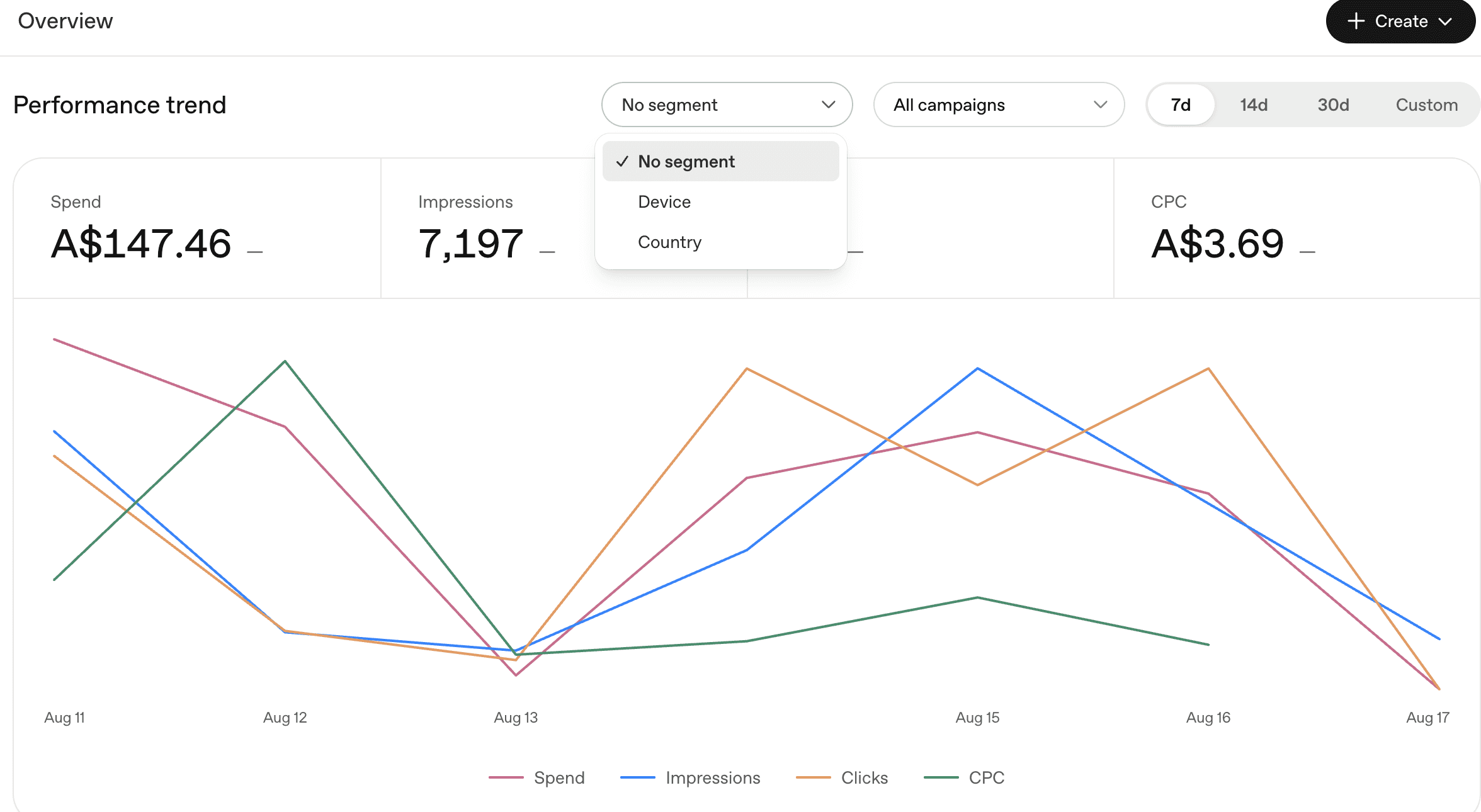
We also found the CPM's compared to Meta were cheaper for our niche (agency), however, ours is relatively high. Our Meta Ads CPM's can sit between $70-$90, whereas for us ChatGPT ads sat closer to $20-$40. From a CPC perspective, these were equivalent to about a $3-$5 CPC.
Asset Requirements for ChatGPT Ads (And What Works)
ChatGPT Ads is still early, so the spec sheet is short compared to what you're used to with Google or Meta. Right now there's just one ad format: a square image with a 1:1 aspect ratio at a minimum of 256×256 pixels, a headline capped at 30 characters, and body copy capped at 60 characters. The full unit also needs an advertiser name, a favicon or small logo, a title, ad copy, and a landing page.
A couple of practical notes before you brief your designer:
Export bigger than the minimum. 256×256 is the baseline: upload at 512×512 or 1024×1024 so the image stays sharp once it's scaled down into the small thumbnail size it actually renders at.
File formats: JPG, PNG, or WEBP are all accepted.
Your favicon is a separate asset from the main image, a clean, square version of your logo mark.
Check your landing page's crawler access. OpenAI verifies destination URLs with two bots, OAI-AdsBot and OAI-SearchBot: if your robots.txt, CDN, or firewall blocks them, the ad gets approved but won't deliver, which is an easy thing to miss if you're not looking for it.
What the creative should actually look like
Because there's only one small image sitting next to a couple of lines of text, this isn't the place for a busy, layered design. A simple square visual built around a single object reads far better at thumbnail size than anything cluttered.
On copy, the platform is built around context rather than keywords, so the tone should feel more like a helpful suggestion than a sales pitch. The best-performing ads read like a recommendation rather than a banner ad, vague headlines and generic sales language tend to underperform because they don't match how people are actually using ChatGPT in the moment. OpenAI's own guidance backs this up: clear, specific, benefit-focused copy. Explaining what you offer, who it's for, and when it helps, consistently outperforms a catchy line or a generic call to action.
Worth building more than one version, too. A wider set of title and copy variations per offering gives the system more opportunities to match your ad to relevant conversations.
Setting Up Accurate Tracking for ChatGPT Ads
This is where most businesses will trip up. Because OpenAI's own reporting is limited, you need your tracking to do the heavy lifting.
UTM-tag every link you use in ChatGPT ad creative, and keep a consistent naming convention so you can isolate this channel in GA4.
Set up server-side or enhanced conversion tracking on your site so you're not relying solely on browser-based pixels, which are increasingly blocked or limited.
Create a dedicated channel grouping in your analytics platform so ChatGPT traffic isn't lumped in with "referral" or "direct."
Cross-reference with your CRM, especially for B2B, since ChatGPT-driven leads may have longer consideration cycles.
If your business runs on GA4 and BigQuery, this is a good moment to revisit your data setup, our piece on how we use BigQuery for data warehousing covers how to build a source of truth that doesn't depend on any single platform's dashboard.
(Suggested image: screenshot of a UTM-tagged link structure or a GA4 channel grouping report showing ChatGPT as a source.)
How Targeting Works (So Far)
Targeting is contextual and demographic, not yet behavioural or intent-based in the way Meta or Google Display targets. Based on our testing, you can currently narrow by:
Broad location (country/state level in Australia, not yet suburb-level)
Age range
Device type
Topic category the conversation falls into (e.g. travel, finance, software)
There's no custom audience upload, no retargeting pixel, and no lookalike modelling yet. That will likely change, but for now, your targeting strategy needs to lean on strong creative and category relevance rather than precision audience slicing.
How to Get Agency Access to a ChatGPT Ads Account
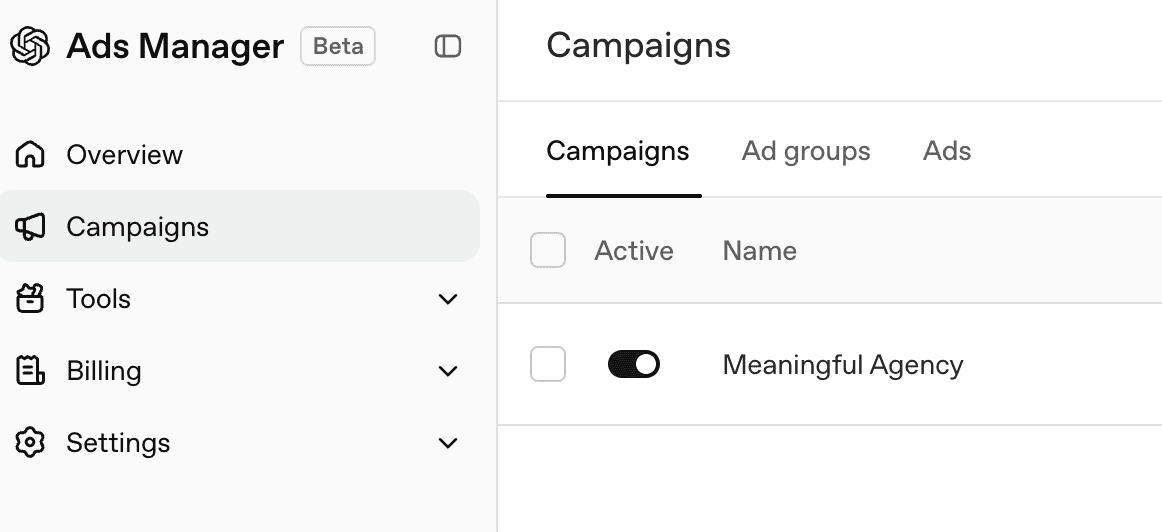
If you're working with an agency (like us), here's the current process:
The business creates or confirms its OpenAI advertiser account.
Access is granted via an invite or role assignment within the ads interface, similar in concept to Google Ads' manager account linking, though the interface is still basic.
Head to Settings > Users > Invite
Billing typically stays attached to the business's own payment method, with the agency managing campaign setup and optimisation.
Because self-serve access is still being rolled out in waves, some agencies (including us) are managing this through early partner access rather than a fully public sign-up flow.
If you're already running Google Ads or paid social through an agency, the account structure will feel familiar, just less mature.
What You Need to Get Started
Before you launch, make sure you have:
A clear objective (brand awareness vs. lead generation vs. traffic), since bidding tools are limited.
UTM-tagged, tracked landing pages ready to go.
Creative that reads naturally in a conversational context.
Realistic budget expectations. This is a test-and-learn channel in 2026, not a scaled performance channel yet.
Patience with reporting gaps. You'll need to triangulate data from your own analytics rather than relying on the platform alone.
Should Your Business Test ChatGPT Ads Now?
If you have budget to experiment and a brand that benefits from being present where people are researching, yes, it's worth a small test. If you need immediate, measurable ROAS, keep your primary budget in Google Ads or Meta and treat ChatGPT as a satellite test.
This mirrors what we've seen with other AI-driven shifts in search behaviour. Our guide to Google's AI Mode covers a similar dynamic: the platforms are changing faster than the measurement tools around them, so businesses that get their tracking foundations right now will be the ones who can prove value once the ad products mature.
For a broader view of how paid search is evolving alongside AI platforms, our Google Ads vs AI search advertising breakdown is a useful companion read.
Conclusion
ChatGPT ads are real, live in limited form in Australia, and currently CPM-based with basic contextual targeting. Measurement is the biggest gap right now, so your own tracking setup matters more than the platform's native reporting. Treat 2026 as the test phase: get your tracking right, run small budgets, and be ready to scale once OpenAI's ad tools catch up to Google and Meta.
If you want help setting up a test campaign, tracking it properly, and reporting on it in a way that actually holds up, that's exactly the kind of work we do across our paid media services.
Chat GPT Ads: A Complete Guide For Businesses (2026)