Creative Diversity in Meta Ads: New Metric Explained



Meta now shows you a creative diversity score right inside Ads Manager, and it's changing how smart advertisers plan their creative. If you're building Meta Ads campaigns and only testing minor variations of the same image and headline, you're likely leaving performance on the table and the platform will now tell you so.
Creative diversity is a specific, measurable input into how well your ads perform, how Meta's algorithm treats your account, and whether your audience actually trusts what they're seeing. This guide covers what it means, why it matters for Meta Ads specifically, how to read the new column in your account and what to do if your score needs work.
What Is Creative Diversity?
Creative diversity is the range of distinct creative concepts, formats, messaging angles, and visual styles you run within a campaign or account, rather than just swapping colours or cropping the same photo five different ways.
Definition and Core Concept
In an advertising context, creative diversity covers a few overlapping things:
Format diversity: static images, video, carousels, Reels, collection ads.
Message diversity: different value propositions, hooks, or emotional angles (price, convenience, social proof, urgency).
Representation diversity: who and what appears in your creative, including different people, settings, and use cases that reflect your actual customer base.
Structural diversity: different pacing, length, and creative "shape" (UGC-style clips versus polished brand video, for example).
The key distinction is that diversity here means meaningfully different creative, not ten versions of one ad with a different button colour. Meta's systems (and your audience) can tell the difference.
Creative Diversity vs. Workforce Diversity vs. Cognitive Diversity
These terms get mixed up often, so it's worth separating them:
Workforce diversity is about who is on your team, in your agency, or in your creative department.
Cognitive diversity is about how differently your team members think, solve problems, and approach a brief.
Creative diversity is the output: the actual range of ideas, formats, and representation that ends up in market.
You can have a diverse team and still produce narrow, repetitive creative if your process doesn't push for variation. Conversely, a small team can produce genuinely diverse creative if they deliberately test different angles. This article focuses on the output, particularly as it relates to Meta Ads performance.
Why Creative Diversity Matters in Meta Ads
Creative diversity matters because Meta's ad delivery system rewards it, audiences respond better to it, and it protects your brand from the reputational risk of tone-deaf campaigns. It's a performance lever, not just an ethical checkbox.
Meta's Algorithm and How It Works
Meta's delivery system tests multiple creative variants against different audience segments to find the best-performing combinations. If every ad in an ad set looks and sounds the same, the algorithm has very little to differentiate between, which limits how effectively it can optimise delivery.
Broader creative input gives Meta's system more signal to work with. This is part of why campaigns with several genuinely distinct creative concepts tend to outperform those running near-identical variations, especially once an account moves into Advantage+ style automated campaigns where the system leans heavily on creative variety to find winning combinations. If you want the full picture on choosing the right campaign structure to pair with your creative approach, our guide on Meta ad objectives is a useful companion read.
Authentic Representation and Audience Trust
Audiences can spot stock-photo sameness immediately, and it costs you trust. When your creative reflects the actual diversity of your customer base (different ages, body types, family structures, cultural backgrounds, ability levels), people are more likely to see themselves in the ad and believe the product is genuinely for them.
This matters more on Meta than on many other channels because ads appear in-feed, next to organic content from friends and family. Creative that feels manufactured or exclusionary stands out for the wrong reasons.
Innovation and Idea Generation
Testing a wider range of creative concepts is also how you find your next big winner. Teams that only ever produce "safe" variations of an existing control ad rarely stumble onto a genuinely new angle. Deliberately building diversity into your creative briefs forces your team (or agency) to explore formats and messages they wouldn't otherwise try.
Risk Reduction (Avoiding Tone-Deaf or Exclusionary Campaigns)
A narrow creative process is also a risk. If the same handful of people, scenarios, or assumptions get reused across every campaign, it's easy to miss a blind spot until a campaign is live and audiences call it out. Building diversity checks into your creative review process is a practical way to catch this before it becomes a PR headache rather than after.
How to See Your Creative Diversity Measure in Meta Ads: The New Column
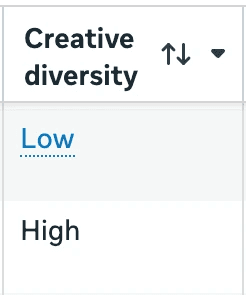
Meta has added a creative diversity column directly inside Ads Manager, giving advertisers a measurable score for how varied their active creative actually is. Here's how to find it and what it's telling you.
To locate the creative diversity column in your account:
Log in to Meta Ads Manager and open the Ads tab (or Campaigns/Ad sets, depending on the level you want to review).
Click Columns, then select Customise Columns.
Search for "creative diversity" in the column search bar.
Tick the box to add it, then save your customised column set (name it something like "Creative Health" so you can reuse it).
Apply the view to see the score populate against your active ad sets or campaigns.
How to read it:
The column gives you a relative indication of how varied your active creative is within a given ad set or campaign, rather than a single universal benchmark. We'd recommend checking it at an adset level, and aiming for high creative diversity.
A low score typically signals that your active ads are visually or structurally similar to one another (same format, same layout, same type of imagery).
A higher score suggests you're running a genuine spread of formats, angles, and visual styles.
Use it as a diagnostic alongside your usual performance metrics (CTR, CPA, frequency), not as a replacement for them. A high diversity score with poor performance still means your concepts aren't landing; a low score with strong performance may mean you've found a control worth protecting while you test around it.
What to do with the reading:
If your score is consistently low, audit your active ads for repeated formats or messaging and brief in at least one or two genuinely different concepts.
Rotate in different creative types deliberately: pair a polished brand video with a UGC-style clip, or test a carousel against a single static image with a different hook.
Recheck the column after a fresh batch of creative goes live to see whether your changes actually moved the needle.
If you're not sure how your current account stacks up, this is exactly the kind of health check our paid social team runs as part of ongoing Meta Ads management.
How to Increase Your Creative Diversity
The fastest way to lift a low creative diversity score is to deliberately brief in different content types rather than more variations of the same one. For service-based businesses in particular, this doesn't need a big production budget, it needs a spread of formats and angles that each do a different job.
Here are the core creative types worth testing:
UGC (user-generated content): raw, phone-shot style clips of real customers or staff talking through a service, result, or experience. This format tends to perform well because it looks like organic content rather than an ad, which builds trust in-feed.
Problem/solution videos: a short piece that opens on a pain point your customer actually has, then shows how your service resolves it. This works particularly well for service businesses because it demonstrates value rather than just describing it.
Founder or team videos: the person behind the business speaking directly to camera about why the service exists, how it works, or what makes it different. This adds a face and a voice to the brand, which is hard to fake and builds credibility quickly.
Relatable content: light, everyday moments or observations that your ideal customer would recognise in themselves, even if the ad isn't directly selling anything in the first few seconds. This format is useful for reaching people earlier in their journey, before they're actively searching for your service.
Static comparisons or offers: a single clean image testing a different hook, price point, or value proposition against your video-led creative. Statics are quick to produce and are a simple way to add format spread without a full shoot.
Carousels: a multi-step format for walking through a process, before-and-after results, or a step-by-step explanation of your service.
For a service business, a solid starting test set might pair one UGC-style testimonial, one problem/solution video, one founder-to-camera video, one relatable or "day in the life" style piece, and a couple of statics testing different offers or hooks. That spread alone will usually move your creative diversity score, and it gives Meta's algorithm genuinely different signal to optimise against.
If you want a practical breakdown of building short-form video specifically, our guide on creating Instagram Reels and TikTok videos for your brand covers formats and production tips in more depth.
Common Challenges and How to Overcome Them
Most teams don't struggle with wanting creative diversity, they struggle with executing it consistently under real-world constraints like budget, brand guidelines, and leadership buy-in.
Avoiding Tokenism
Diversity that's added as an afterthought (one token ad with different representation, everything else unchanged) is usually obvious to audiences and doesn't move your creative diversity score meaningfully anyway. The fix is to build variety into the brief from the start, not patch it in during review.
Balancing Brand Consistency with Diverse Expression
Brand guidelines exist for good reason, but overly rigid templates are often the root cause of low creative diversity scores. Instead of locking down exact layouts, define what must stay consistent (logo use, colour palette, tone of voice) and leave format, casting, and structure genuinely open within those guardrails.
Getting Leadership and Budget Buy-In
The easiest way to win this argument internally is to frame creative diversity as a performance lever, not a values statement. Point to the new Meta column as evidence the platform itself is measuring it, and tie any creative diversity initiative to a specific metric you already report on, like CPA, CTR, or frequency.
Tools and Resources to Support Creative Diversity
You don't need a huge budget to build a genuine creative diversity practice, you need a repeatable process and a way to check your own blind spots.
Diversity Auditing Frameworks
A simple internal audit doesn't need to be complicated. At a minimum, review your active ad set against a short checklist each time you launch a new batch of creative:
Format spread: do you have at least two structurally different formats live at once (e.g. video and static, or carousel and single image)?
Messaging spread: are you testing more than one core hook or value proposition?
Representation spread: does the range of people and scenarios in your active ads reflect the range of people who actually buy from you?
Source spread: do you have a mix of polished brand content and more raw, UGC-style content?
Run this checklist alongside the native creative diversity column in Ads Manager, and you'll catch most issues before they show up as a flat score or a plateauing campaign. If you'd rather have a specialist team build and manage this process for you, our Meta Ads library guide is a good next read for understanding what competitors are already running, and our paid social ads service can take the whole creative testing cycle off your plate.
Creative Diversity in Meta Ads: New Metric Explained